


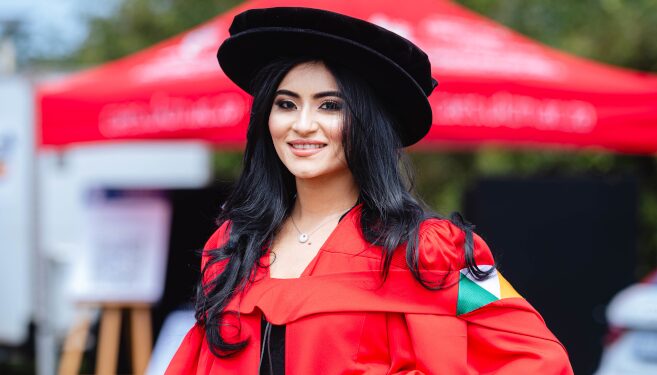
Concern and curiosity about the nature of the infrastructure building process impacting certain groups in Cape Town and Durban led to Dr Kiara Rampaul embarking on a PhD study.
Rampaul’s dissertation was titled: ‘The Design and Use of Public Space for Women and Girls in South African Cities: A Case of the Cities of Durban and Cape Town’.
Rampaul’s academic journey began in 2016 when she enrolled for a Bachelor of Social Sciences in Housing at UKZN. It was that foundation that gave her an understanding of how the built environment and human wellbeing are deeply connected. This sparked a fierce desire in Rampaul to get a better understanding of Town and Regional Planning, and in turn the realities of how planning decisions can unintentionally exclude certain groups such as women and girls.
She says there were still deeper questions to be asked, especially around gender, equity and the everyday use of public spaces.
As an urban feminist committed to challenging traditional planning approaches that overlook women and girls, Rampaul decided to examine how our cities could be reimagined to be more inclusive, safe and empowering for all, especially for those whose voices are often marginalised in planning processes.
Using her feminist lens, she drew on research methods such as site observations, interviews, and surveys to understand how women and girls experience public spaces with her study asking a simple but powerful question: “What does inclusion look like when you walk in the city as a woman or girl?”
Said Rampaul: “Public spaces often have safety concerns and limited visibility; while design choices can make spaces feel unwelcoming or even restrictive. Young women (18-25) often face heightened vulnerability, while adult women navigate constraints related to caregiving, transit and design exclusions.”
In response, Rampaul developed the HopeScape model – a six-dimensional framework for inclusive public space design.
The dimensions: (1) accessibility, (2) safety and security, (3) identity and expression, (4) inclusive amenities, (5) clear signage, and (6) wayfinding and multi-functionality were derived from both local case studies in Durban and Cape Town, and international examples in Vienna (Austria), Copenhagen (Denmark), and Tunis (Tunisia).
According to Rampaul, the six dimensions act as benchmarks for identifying what makes spaces truly inclusive, guiding planners, architects, and policymakers in creating public spaces that welcome all bodies, promote freedom of movement, and foster dignity and belonging. “HopeScape is not just a model, but a call to action to rethink urban spaces as platforms for equity, empowerment and transformation,” she said.
Apart from her goal to make South African cities safer, more inclusive, and empowering for women and girls, she believes that integrating lived experiences with both local and international best practices would be beneficial to those communities. Her findings demonstrate that public spaces are more than just physical locations, they are expressions of justice, identity, and community belonging. “When cities are designed with equity in mind, they become platforms for empowerment, dignity and social connection, benefiting women, girls and society as a whole,” she said.
Balancing her academic journey with other interests and achievements has been rewarding. She is proud about her successes which include being a former Miss India South Africa to being a member of the Golden Key International Honour Society. She has been recognised as a South African Council for Planners (SACPLAN) Young Planning Professional in both the private sector (2024) and academia (2025), as well as a SACPLAN Top Women in Planning Rising Leader (2024).
Rampaul shared that each experience, from research and fieldwork to mentorship, awards, and public engagement had complemented the other, shaping her into a holistic, resilient and socially conscious professional.
About her PhD, she says that it feels surreal, exciting and deeply rewarding, admitting that completing her doctorate at the age of 27 has been a crazy and humbling journey, however, she admits she could not have done it without family support and that of her supervisor, Professor Hangwelani Magidimisha-Chipungu, whose guidance and mentorship were instrumental throughout the journey.
Her parents had been her pillars of strength. “My sister has also been an incredible part of this journey; she has been my pillar of fun, keeping me sane, grounded and laughing through the long hours of research and writing. Together, my family has provided both the support and the balance that made completing my studies possible,” said Rampaul.
Rampaul is currently a postdoctoral researcher at UKZN, working in partnership with the KwaZulu-Natal Cooperative Governance and Traditional Affairs (KZN COGTA) on planning resilient human settlements. Her work focuses on policy and framework development to strengthen disaster risk reduction, preparedness and recovery, following the April 2022 floods in KwaZulu-Natal.
“I plan to continue contributing to research and practice that enhances climate and disaster resilience in South African settlements, while ensuring that planning and policy are inclusive, context-sensitive, and grounded in the lived realities of communities.”
She quotes the saying: “Fall down seven times, stand up eight”, for encouragement to her peers, believing that “everything in life whether good or bad, is a lesson. Learn from it, adapt and keep moving forward.
“Doing research, especially in fields such as urban planning and the built environment, requires staying connected to the real-world impact of your work. Consequently, one must engage with the communities, spaces and issues you are studying,” she said. “Let your curiosity, empathy and commitment guide you, and remember that your research can make a tangible difference in people’s lives.”